Fire door and fire exit are often used as if they mean the same thing. They do not.
Both are important parts of a building’s fire safety arrangement, but they have completely different purposes. Understanding the difference can help building owners and facility managers identify problems before an emergency occurs.
For commercial and residential properties in Ajman, Dubai and across the UAE, both fire doors and emergency exits should be considered as part of the overall means of escape and fire protection strategy.
What Is a Fire Door?
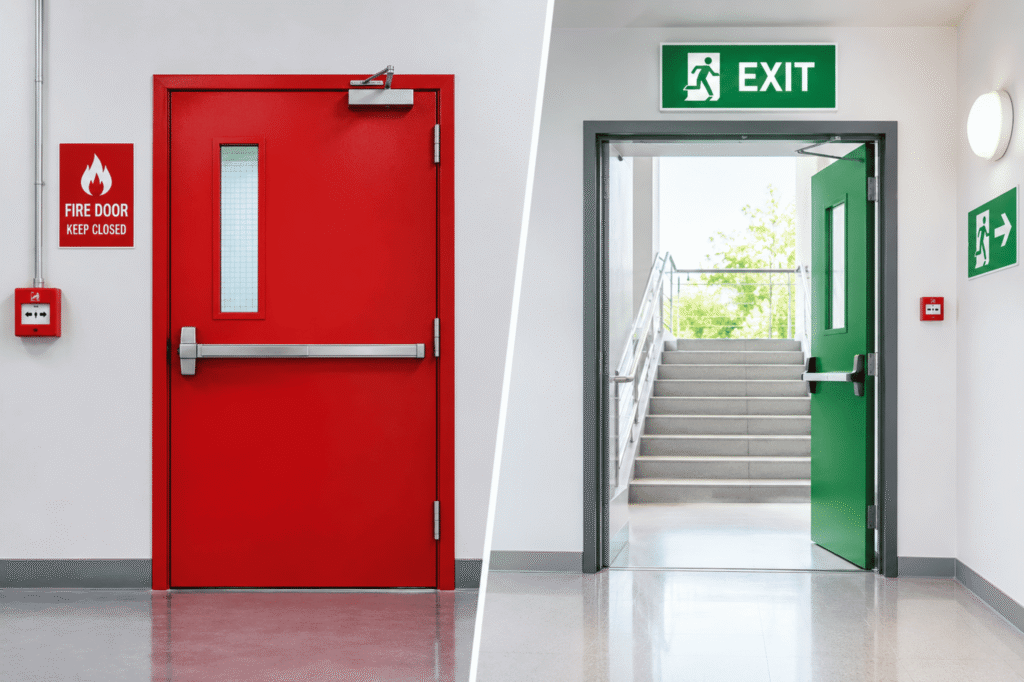
A fire door is designed to help restrict the spread of fire and smoke between different areas of a building for a specified period, depending on its design and rating.
You may find fire doors at:
- Staircase entrances
- Corridors
- Protected passages
- Service areas
- Plant rooms
- Between different fire compartments
The purpose is not simply to provide another way out. A fire door helps protect people and other parts of the building by limiting the movement of fire and smoke.
A common mistake
A fire door is sometimes kept permanently open because employees find it inconvenient to close.
If the door is designed to provide fire separation, keeping it open can affect its intended function. Where an approved hold-open arrangement is provided, it should operate as designed.
What Is a Fire Exit?
A fire exit is an exit route or door intended to help people leave a building safely during an emergency.
A fire exit should lead occupants towards a safe area or the appropriate escape route.
Fire exits are particularly important in:
- Offices
- Shopping and retail spaces
- Warehouses
- Schools
- Hotels
- Factories
- Restaurants
- Large residential and commercial buildings
The exact escape arrangement depends on the building layout, occupancy and applicable requirements.
Fire Door vs Fire Exit — The Simple Difference
Think of it this way:
Fire Door = Helps contain fire and smoke.
Fire Exit = Helps people escape from the building.
A door can sometimes serve both functions depending on its design and location, but the terms should not automatically be treated as interchangeable.
Why Both Matter During a Fire
Imagine a fire starts in one section of a commercial building.
A properly functioning fire door can help limit the spread of fire and smoke into another protected area.
At the same time, a clearly identified and accessible fire exit gives occupants a route to move away from danger.
One helps with containment.
The other helps with evacuation.
Together, they form part of a building’s overall fire safety strategy.
Common Problems Facility Managers Should Watch For
Even when a building has fire doors and marked exits, everyday use can create problems.
Fire doors
Common issues include:
- Door closer not working
- Damaged door or frame
- Door not closing fully
- Damaged seals
- Door permanently wedged open
- Unapproved modifications
Fire exits
Common issues include:
- Exit routes blocked by storage
- Poorly visible exit signs
- Furniture restricting the route
- Doors that are difficult to operate
- Changes to the building layout affecting escape routes
These issues should be addressed rather than waiting for the next inspection.
What Happens After Renovation?
Renovation is one situation that facility managers should pay particular attention to.
Adding partitions, changing office layouts, converting storage areas or modifying doors can affect both fire compartmentation and escape routes.
This is especially relevant for commercial properties in Ajman and Dubai, where warehouses, workshops and offices may be modified as business requirements change.
Properties in Dubai and Ajman should likewise consider the applicable local building and fire safety requirements when making changes.
A Simple Way to Remember
When walking through your building, ask two questions:
“If a fire starts here, can fire and smoke be contained?”
“If people need to leave, can they reach a safe exit without obstruction?”
The first question relates to fire protection and compartmentation, including appropriate fire doors.
The second relates to safe evacuation and fire exits.
Both need attention.
Fire Safety Support Across Ajman & UAE
Firecon Fire Fighting Equip & Maint Fixing L.L.C. supports commercial and industrial properties with fire safety inspection, fire fighting system maintenance, fire alarm maintenance, emergency lighting and other fire protection services.
We support properties in Ajman and Across the UAE, helping facility managers identify visible fire safety concerns and maintain their systems.
If your building has recently been renovated, changed its layout or has concerns about fire doors and escape routes, a professional fire safety inspection can help identify potential issues.
Need a fire safety inspection for your property? Contact Firecon to discuss your requirements.
Frequently Asked Questions
Is a fire door the same as a fire exit?
No. A fire door primarily helps limit the spread of fire and smoke, while a fire exit provides a route for occupants to escape safely.
Can a fire door also be an exit door?
In some building arrangements, a door can serve more than one function. Its suitability depends on its design, location and the applicable requirements.
Can fire doors be kept open?
A fire door should not simply be wedged open if doing so prevents it from performing its intended function. Approved hold-open arrangements, where provided, should operate correctly.
Why should fire exits remain clear?
Obstructions can slow evacuation and make it harder for people to reach a safe area during an emergency.
Does this apply to buildings in Ajman?
Yes. Fire doors and safe escape arrangements are important for commercial, industrial and other occupied buildings across the UAE, with specific requirements depending on the property and applicable authority requirements.